

OBJECTIVE OF FOREST SHUFFLE: Build the highest-scoring forest by planting trees and adding animals, plants, and mushrooms that score through card combinations and synergies.
NUMBER OF PLAYERS: 2–5
MATERIALS: 180 cards, including 66 trees, 92 split forest-dweller cards, 3 Winter cards, 5 Cave cards, and 14 reference cards, plus a clearing board, scorepad, and rulebook
TYPE OF GAME: Card game (set collection, hand management, tableau building)
AUDIENCE: Ages 10+
OVERVIEW OF FOREST SHUFFLE
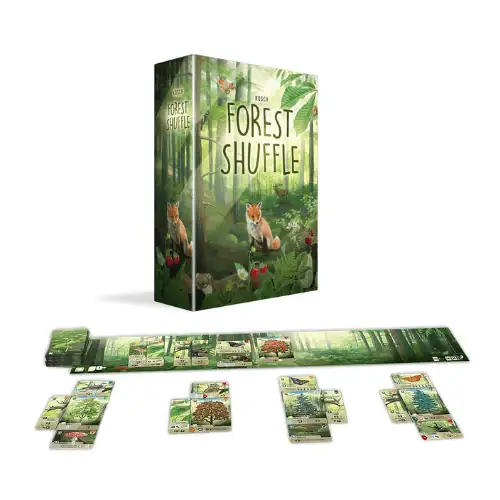
Forest Shuffle is a card game about building a balanced woodland ecosystem from trees, animals, plants, and mushrooms. Kosch designed the game, and Lookout Games released it in 2023. It supports two to five players ages 10 and up, with an official playing time of 60 minutes.
On each turn, you either draw two cards or play one. Trees form the foundation of your forest and provide four spaces for forest dwellers. Most other cards are split into two halves, and only the half you choose to play remains visible.
Playing cards usually means discarding other cards into the shared clearing, where opponents can later draw them. Three Winter cards determine the end of the game. When the third appears, play ends immediately and everyone scores their forest.
FOREST SHUFFLE BOARD GAME SETUP
Place the clearing board in the center and keep the 14 reference cards nearby. Each player receives a Cave card. Set aside the three Winter cards and shuffle the other cards.
Remove cards unseen depending on the number of players:
- 2 players: Remove 30 cards
- 3 players: Remove 20 cards
- 4 players: Remove 10 cards
- 5 players: Remove none
Divide the remaining deck into three roughly equal piles. Shuffle two Winter cards into one pile and place the third Winter card on top of it. Place the other two piles above this one so all Winter cards are in the bottom third of the deck.
Deal six cards to each player. There is no mulligan if your starting hand contains no tree. Lookout removed this rule from the official game. Choose a starting player and continue clockwise.
HOW TO PLAY FOREST SHUFFLE
Each turn, choose one of two actions: draw two cards or play one card. Resolve the action, check the clearing, and then pass play to the next player.
How Does Drawing Cards Work?
Draw two cards one at a time. Each can come from either the face-down deck or the face-up clearing, so you can combine both sources.
Your hand limit is 10 cards. If you have nine cards, you can draw only one. If you already have ten, you cannot choose the draw action.
When you draw a Winter card, reveal it beside the clearing and draw a replacement. The first two signal that the game is nearing its end. Drawing the third Winter card ends the game immediately.
How Do You Play a Card?
Pay the cost shown on the card by placing the required number of cards from your hand face up in the clearing.
Normal tree cards are placed upright and provide four attachment spaces: top, bottom, left, and right. Whenever you play a normal tree, reveal the top card of the deck and add it to the clearing.
Forest-dweller cards are split horizontally or vertically. Choose one half and slide the card beneath a tree so that only your chosen forest dweller remains visible. The concealed half does not count as part of your forest.
What Are Tree Saplings?
Any card in your hand can be played face down for free as a tree sapling. A sapling provides the same four attachment spaces as a normal tree, making it useful when you do not have the tree card you need.
However, a tree sapling has no tree species. It therefore cannot satisfy requirements that depend on a particular tree species.
How Do Effects and Bonuses Work?
Card effects are optional. Depending on the card, an effect can provide an additional action or another benefit.
Some cards also provide colour bonuses. To receive one, every card used to pay the cost must match the required colour or tree symbol. Using even one non-matching payment card prevents the bonus from activating.
If a played card provides both an effect and a bonus, resolve them in this order: effect first, bonus second.
Mushrooms work somewhat differently from many cards with immediate effects. They generally provide permanent effects that remain active and can affect later turns when their conditions are met.
What Happens When the Clearing Fills Up?
Cards spent as payment are placed in the clearing, where other players can draw them. Playing normal trees also adds cards to this shared area.
At the end of a turn, check the clearing. If it contains more than nine cards, remove all cards in it from the game.
This creates an important tactical choice. Spending a useful card can give an opponent access to it, while filling the clearing can remove the entire selection.
HOW DOES FOREST SHUFFLE END AND HOW DO YOU SCORE?
The game ends immediately when the third Winter card is drawn. There is no final turn or final round.
Players then score the visible cards in their forests according to their individual scoring conditions. Many cards reward combinations involving particular species, trees, or other forest dwellers.
Only the visible half of a split card belongs to your forest. The concealed half underneath a tree does not provide its species, scoring condition, effect, or bonus.
Certain card effects allow you to place cards beneath your Cave. Cards cannot simply be moved there whenever you choose. At the end of the game, each card stored under your Cave is worth 1 point.
Add all applicable points together. The player with the highest score wins.
WHICH FOREST SHUFFLE EXPANSIONS ARE AVAILABLE?
The original Forest Shuffle currently has three main expansions:
- Alpine (2024): Adds 36 cards featuring mountain species and two additional tree species.
- Woodland Edge (2024): Adds 36 cards focused on species living around the transition between forest and meadow.
- Exploration (2025): Adds an Automa for solo play, asymmetric Cave cards, 12 challenges, and additional cards.
Forest Shuffle: Dartmoor (2025) is a standalone game rather than an expansion for the original Forest Shuffle. Its own Dartmoor: Exmoor expansion followed in 2026.
Forest Shuffle: Smoky Mountains is another standalone title in the series, scheduled for October 2026. It moves the setting to North America and introduces a new ecosystem and mechanics.
FAQ
Lookout Games officially lists the playing time as 60 minutes. Individual sessions may vary depending on the number of players and how familiar everyone is with the cards.
The base box does not contain solo components, but Lookout offers an approved downloadable Automa. Forest Shuffle: Exploration includes physical Automa cards as well as asymmetric Cave cards and 12 challenges.
No. An earlier version of the rules allowed players without a tree to replace their six starting cards, but Lookout removed this mulligan from the official rules. You can instead use any card face down as a tree sapling.
Yes. Any card can be played face down for free as a tree sapling. It provides four attachment spaces but has no tree species.
No. Only the visible forest dweller counts as part of your forest. The concealed half underneath the tree does not contribute its species, effects, bonuses, or scoring conditions.

- 23 SUPER FUN 4TH OF JULY GAMES - July 2, 2026
- 15 Hilarious 4th of July Drinking Games - July 2, 2026
- 30 Summer Camp Games - July 2, 2026